1.Background of the Directorate
Livestock and fisheries research to underpin sustainable development and growth of the livestock and fisheries industries in the Republic of South Sudan constitutes a priority investment area for the national Government.
In the past, research activities were conducted successfully in Malakal Veterinary Research Laboratory (MVRL) until the signing of the Addis Ababa agreement in 1972, when the facilities were removed to Soba Central Veterinary Research Laboratory. It was at MVRL that the production of caprinised rinderpest vaccine was carried out before the serum and tissue cultured vaccine, Kabete “O” strain, was introduced, in 1956 and 1958, respectively.
In 1978, a Veterinary Diagnostic Laboratory was established in Wau by a German veterinary team within the premises of the State Ministry of Animal Resources and Fisheries. The facility, initially comprising laboratories for parasitology, bacteriology and haematology, was established to facilitate livestock disease survey and diagnosis in the then Greater Bahr El Ghazal Province. Subsequently, in 2010, additional laboratories for clinical pathology and serology were added.
In 1980, the May Veterinary Research Laboratory was established in Juba, with units for virology, bacteriology, mycology, pathology, serology, epidemiology and vaccine production. Prior to war, the vaccine production unit produced one batch of vaccine for Contagious Bovine Pleuro-Pneumonia (CBPP).
Over the devastating civil war years, from 1983 to 2005, veterinary research and diagnostic activities deteriorated in Wau and there was a total collapse in the Juba and Malakal laboratories. In 2003, the Ministry of Science and Technology of the Government of National Unity, Khartoum, attempted to revive the Juba and Malakal laboratories, but with little success.
After the Comprehensive Peace Agreement (CPA), three laboratories were constructed, in 2008, at the MLF premises at Gudele II, Juba. The larger laboratory, a pre-fabricated construction, was intended as a research laboratory, with the two smaller wood-construction laboratories, provided under USAID support, for disease diagnosis. The CPA also ushered in a new era of peace, reconstruction and development, and donor funds, channelled initially through the Multi-Donor Trust Fund (MDTF) were used by the MARF to implement the Livestock and Fisheries Development Project in five States (Upper Nile, Unity, Jonglei, East and Central Equatoria).
Amongst the many activities, construction and development of a Central Veterinary Laboratory (CVL) with diagnostic and research functions in Juba, was planned, together with refurbishment of the two regional laboratories in Wau and Malakal. However, while some work was done at the Wau laboratory, it was only possible, with the availed funds, to fence the National Research Laboratory (NRL) construction site at Rejaf West and construct a guard house. The need to construct a permanent National Research Laboratory remains and is of critical importance.
Livelihoods of the majority of the population of the Republic of South Sudan are livestock-dependent, and improvement and commercialisation of livestock production have been identified as key to improving livelihoods and ensuring the substantial contribution of the livestock and fisheries industries to the national economy. This can only take place with the support of effective institutions that will enable South Sudan to meet quality and health standards laid down by the World Organisation for Animal Health (OIE) and trading partners. The effective institutions needed necessarily include an effective capacity for livestock and fisheries research and development, crucial to which is a properly-functioning National Research Laboratory, capable of providing quality routine diagnostic facilities, serving as a referral laboratory for the regional laboratories, supporting vaccine research and production, and conducting other pertinent livestock and fisheries research of importance for South Sudan.
Little progress has been achieved in animal production and fisheries research since the establishment of the Ministry of Livestock and Fisheries, but in the past, there were livestock development centres; for example, the MAFAO dairy and poultry production units at Bilinyang, near Juba, the Marial Bai dairy farm near Wau, the Nyankot livestock centre for ranch improvement in Rumbek, and the Kapoeta sheep fattening centre in Eastern Equatoria State. A fisheries training centre was also opened at Padak near Bor in Jonglei State.
Whilst the MLF is cognisant of the current economic situation and the high cost of establishing an appropriate level of research and development capability to support commercialisation of livestock and fisheries, it is considered essential to make substantive investments in this area, if the livestock and fisheries productive sectors are to be developed and make substantive contributions to the national economy.
2. Vision, Mission and Functions
2.1 Vison of the Directorate
To achieve effective, sustainable and integrated Livestock and Fisheries Development in South Sudan.
2.2 Mission of the Directorate
To support the establishment of a participatory, demand-driven, pluralistic and sustainable livestock and Fisheries research system that provides efficient and effective needs-based, research, in support of all categories of livestock farmer and fisher folk, to enable them to optimize their use of resources for the promotion of sustainable socio-economic development and poverty reduction.
2.3 Functions and Responsibilities
1. Provision and facilitation of research activities
2. Technical guidance in formulation, implementation and review of National Research initiatives;
3. Formulation, implementation, monitoring and evaluation, and coordination of research programmes and /projects;
4. Strengthening collaboration with stakeholders and other service providers;
5. Strengthening linkages with research institutions in development of appropriate technologies;
6. Collection, analysis and management of research information and data and availing it to users and stakeholders;
7. Provision of wildlife/ecosystems research in national parks reserves and protected areas and provision of technical advice to those concerned in order to protect wildlife/ecosystems, increase production and identify areas of potential investment;
8. Mainstreaming gender, environment and other cross-cutting issues in research programmes;
9. Provision of technical guidance on all aspects of research activities;
10. Development of disease control mechanisms, provision of laboratory disease diagnostic services and disease surveillance and improvement of research and production of veterinary vaccines and other biological products;
11. Improvement of animal production research to establish the genetic characteristics of the local breeds and propagation of these breeds through the most recent and suitable technologies for the provision of high productivity of meat, milk and poultry;
12. Developing research in the areas of capture fisheries and aquaculture for national resource management, increase of productivity, attainment of high-quality products and decrease of post- harvest losses;
13. Raising a special consideration to rangeland, fodder and other animal feed resources research
3. Departments
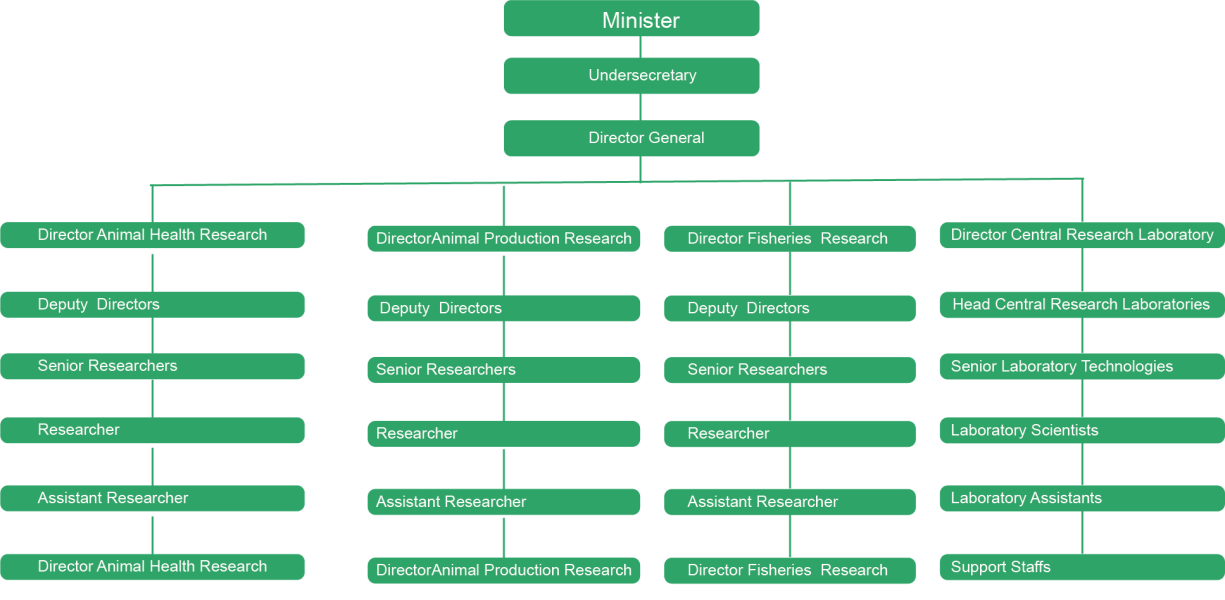
The Directorate of Animal and Fisheries Research and Development comprises of four departments: Animal Health, Animal Production, Fisheries Production, and the Central Research Laboratory. Its mandate is to conduct research and provide technical services that improve the productivity, health, and genetic potential of livestock and fisheries resources in the country. Through research and innovation, the Directorate aims to enhance food security, strengthen the livelihoods of livestock keepers and fishing communities, and promote sustainable development in South Sudan.
3.1 Department of Animal Health
The goal of the Department of Animal Health Research is to improve animal health and livestock productivity through high-quality research, disease surveillance, veterinary diagnostics, and the development of effective disease prevention and control strategies. The Directorate is divided into several units including; pathology, bacteriology, virology, mycology, and others, The Department aims to generate scientific evidence that supports policy formulation, strengthens veterinary services, safeguards public health, and enhances the resilience and livelihoods of livestock keepers while contributing to national food security and sustainable livestock development in South Sudan.
3.1.1 Functions and Responsibilities
The main functions and responsibilities of the Department of Animal Health incudes:
1. Conduct research on livestock diseases, including endemic, emerging, and transboundary animal diseases.
2. Undertake disease surveillance, epidemiological studies, and risk assessments to support evidence-based disease control.
3. Develop and evaluate innovative disease prevention, control, and animal health management strategies.
4. Production of vaccines and antisera against epidemic.
5. Provide veterinary diagnostic and laboratory research services to support disease detection and monitoring.
6. Generate scientific evidence to inform animal health policies, strategies, and national disease control programmes.
7. Collaborate with national and international research institutions to promote innovation and knowledge exchange in animal health.
8. Disseminate research findings through publications, technical reports, training, and stakeholder engagement to improve livestock health and productivity.
3.2 Department of Animal Production
The Department of Animal Production Research is responsible for conducting research to improve the productivity, efficiency, and sustainability of livestock production systems. The Department focuses on animal breeding and genetics, nutrition and feeding, reproduction, pasture and forage development, livestock management, and climate-resilient production technologies. Through scientific research and innovation, the Department generates evidence-based solutions that enhance livestock productivity, strengthen food and nutrition security, increase household incomes, and support sustainable livestock development in South Sudan.
3.2.1 Main Functions of the Department
1) Conduct research on livestock production systems to improve productivity, efficiency, and sustainability.
2) Undertake research on animal breeding, genetics, and reproductive technologies to enhance livestock performance.
3) Carry out research on animal nutrition, feed resources, pasture, and forage development.
4) Develop and evaluate improved livestock management practices and climate-smart production technologies.
5) Generate scientific evidence to support livestock production policies, strategies, and development programmes.
6) Collaborate with national and international research institutions to promote innovation and capacity building in animal production.
7) Disseminate research findings, technologies, and best practices to policymakers, extension services, farmers, and other stakeholders.
3.3 Department of Fisheries Research
The Department of Fisheries Research serves as a key unit responsible for conducting scientific research to support the sustainable development, management, and conservation of fisheries and aquatic resources in South Sudan. Through research on fisheries, aquaculture, fish health, and aquatic ecosystems, the Department generates evidence-based knowledge and innovative technologies that enhance fish production, strengthen food and nutrition security, improve the livelihoods of fishing communities, and inform fisheries policies and management decisions.
3.3.1 The Main Functions of the Department
1) Conduct research on inland fisheries, aquaculture, and aquatic ecosystems to improve sustainable fish production.
2) Assess fish stocks, aquatic biodiversity, and fisheries resources to support sustainable management and conservation.
3) Undertake research on fish breeding, nutrition, health, and aquaculture production technologies.
4) Monitor the health of aquatic ecosystems and evaluate the impacts of climate change and human activities on fisheries resources.
5) Generate scientific evidence to support fisheries policies, regulations, and national fisheries development programmes.
6) Collaborate with national, regional, and international institutions to advance fisheries research, innovation, and capacity building.
7) Disseminate fisheries research findings, technologies, and best practices to policymakers, extension services, fish farmers, and fishing communities.
3.4 Department of Central Research Laboratory
The Department of Central Research Laboratory is the central scientific and analytical unit of the Directorate of Animal and Fisheries Research and Development, with branch laboratory in Juba, Malakal, and Wau. The Department provides laboratory diagnostic, testing, and research support services for animal health, animal production, and fisheries research. It conducts scientific analyses and quality assurance to support disease surveillance, evidence-based research, policy development, food safety, and the sustainable growth of the livestock and fisheries sectors in South Sudan.
3.4.1 The Main Functions of the Department
1) Provide laboratory diagnostic, testing, and analytical services to support animal health, animal production, and fisheries research.
2) Conduct laboratory investigations for the detection, confirmation, and monitoring of animal diseases and aquatic health conditions.
3) Perform scientific analyses and quality assurance of biological samples, feed, water, and other research materials.
4) Production of vaccines, biological products and quality control.
5) Support national disease surveillance, epidemiological studies, and emergency response through laboratory-based evidence.
6) Develop, validate, and standardize laboratory methods, protocols, and quality management systems in accordance with national and international standards.
7) Strengthen national research capacity by providing technical support, laboratory training, and collaboration with research institutions and universities.
8) Generate and disseminate reliable laboratory data to inform research, policy formulation, regulatory decisions, and sustainable livestock and fisheries development.
4. Chart of the Directorate