1.Introduction
The Directorate of Administration and Finance in the National Ministry of Livestock and Fisheied plays a central role in managing human resources, financial operations, and administrative support. Its vision is to ensure efficient, transparent, and accountable service delivery, while its mission focuses on providing professional administration and sound financial management to strengthen governance.
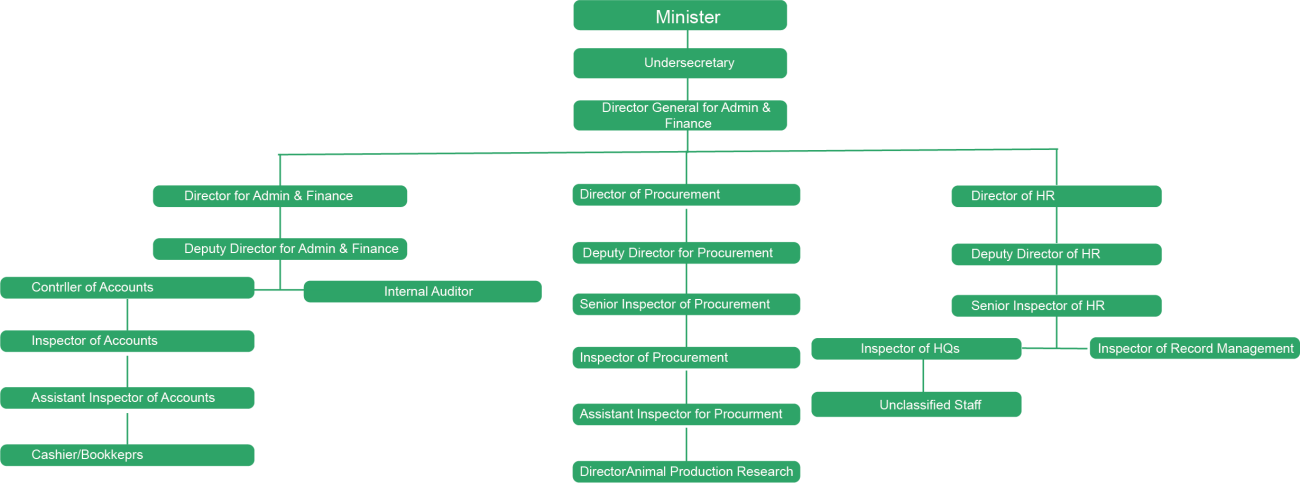
The Directorate is supported by Three Departments:-1) Accounts, 2) Human Resources Management and 3) Procurement
Together, these three Departments form the administrative backbone of the Ministry of Livestock and Fisheries, ensuring that the other eight technical directorates can focus on service delivery while being supported by strong financial, logistical, and human resource systems.
2. Vision, Mission and Functions:
2.1- Vision Statement
“To establish a transparent and efficient administration and finance system that empowers the Ministry of Livestock and Fisheries to sustainably manage animal and fishery resources for food security, livelihoods, and economic growth.”
2.2- Mission Statement
“To deliver professional administrative and financial services that enable effective livestock and fisheries development programs, ensuring accountability, efficiency, and integrity in resource management.”
2.3.1- Strategic Objectives and Functions:-
Financial accountability: Ensure proper budgeting and reporting for livestock vaccination campaigns, fishery development projects, and rural livelihood initiatives.
Human resource development: Build staff capacity through training, maintain updated personnel records, and manage promotions/pensions.
Service delivery support: Provide logistical support for veterinary outreach, fishery station operations, and field missions.
Transparency and integrity: Uphold integrity in payroll, procurement, and expenditure control.
Policy alignment: Ensure administrative and financial operations support national livestock and fisheries strategies.
2.3.2- Expected Outcomes
Improved financial transparency and accountability.
Strengthened human resource systems.
Efficient logistical support for technical directorates.
Enhanced service delivery in livestock and fisheries programs.
Greater alignment with national development priorities.
3- Roles and objectives of DAFs Departments:
3.1- Accounts Department;
Financial management: Prepare budgets, monitor expenditures, and ensure funds are used according to approved allocations.
Payroll processing: Handle salaries, allowances, and pensions for ministry staff.
Financial reporting: Produce quarterly and annual financial statements for transparency and audits.
Revenue management: Record and manage revenues from livestock services, fishery licenses, or donor-funded projects.
Compliance: Ensure adherence to treasury regulations, audit requirements, and financial laws.
3.2-Procurement Department;
Procurement planning: Develop annual procurement plans aligned with ministry priorities (e.g., veterinary drugs, fishing gear, office supplies).
Tendering and contracts: Manage bidding processes, evaluate suppliers, and award contracts transparently.
Supply chain management: Ensure timely delivery of goods and services to support vaccination campaigns, fishery station operations, and field missions.
Inventory control: Maintain records of procured items, track usage, and prevent wastage.
Standards compliance: Follow public procurement laws and donor requirements for accountability.
3.3- Human Resources Management (HRM)
Recruitment and staffing: Manage hiring processes, promotions, and transfers of ministry staff.
Capacity building: Organize training and workshops to strengthen staff skills in livestock and fisheries management.
Employee welfare: Handle pensions, leave, benefits, and disciplinary matters.
Performance management: Conduct evaluations and appraisals to improve efficiency.
Records management: Maintain updated personnel files and ensure compliance with civil service rules.
4- Chart of the Directorate of Administration and Finance