1.Introduction
Animal production is an inheritance, a tradition and a way of life, which for centuries has shaped the thought, outlook, culture, social values and economic life for the majority of South Sudanese. The importance of livestock is equivalent to the significance of the culture and custom of South Sudanese pastoralists. The two are inextricably bound together as part of South Sudan pastoralist identity, culture and heritage.
Animal production, therefore, has been, is, and will continue to be, vital to all strategies for the planned socio-economic development of South Sudan. Growth of agriculture in general and the animal resources sector in particular, is essential, not only to achieve self-reliance at national level, but also for household food security and to bring about equity in the distribution of income and wealth, resulting in rapid reduction in poverty levels.
Animal production on a commercial scale does not exist in South Sudan, though livestock producers, especially pastoralists and agro-pastoralists, have been a very important pillar of the economy of South Sudan. Despite having contributed significantly towards household food security, the well-being of the livestock rearing communities continues to be a matter of great concern in the country.
The demand for livestock products is increasing with the growing population in the urban centres. It is therefore imperative that modern animal production systems, technologies and practices be adopted to maximize benefit from the huge livestock resources in the country. Some of these changes would entail intensive bee, poultry and pig production, and stall-feeding of dairy cattle in urban and peri-urban areas, coupled with appropriately constituted concentrates, and setting up of feedlots to finish off stock.
2.Vision, Mission and Function
2.1. Vision of the Directorate
To be the leader in all technical aspects of animal production and production systems and hence ensure sustainable livestock production and productivity.
2.2. Mission of the Directorate
To support sustainable development of the livestock industry, through the application of appropriate animal production technologies and skills, and in collaboration with stakeholders.
2.3. Functions and Responsibilities
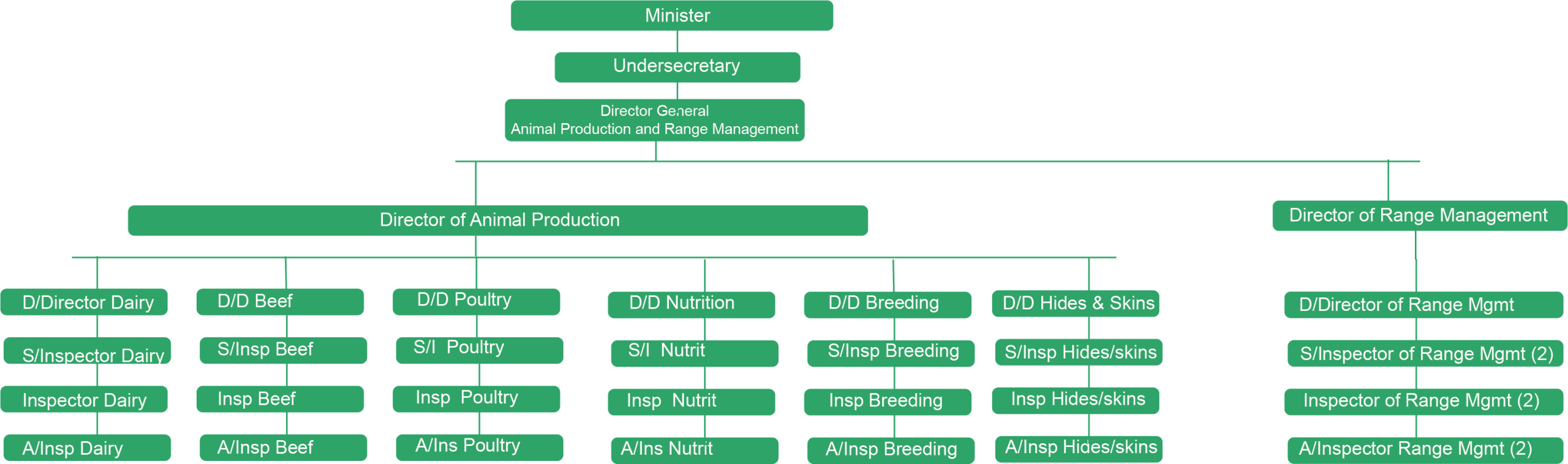
The Directorate is headed by a Director General assisted by two heads of departments for the Department of Animal Production and the Department of Range Management.
3. Departments
3.1. Departments of Animal Production
3.1.1. The main functions of the department
The Functions and Responsibilities:
1. Formulate and prepare policies, strategic plans and programmes to develop animal, bee Keeping, and poultry production in the 10 states of the Republic of South Sudan (RSS);
2. Coordinate and monitor implementation of RSS-funded animal production programmes and projects in the states of the RSS;
3. Provide needed technical assistance in supply and application of available technological options required for transformation of the traditional animal production systems;
4. Promote and coordinate partnership between public sector institutions, private operators and local livestock producers to improve the necessary services provided to animal production activities such as technical advice, credit access and input supply;
5. Develop guidelines and formulate/promote and monitor the implementation of measures and regulations, with the provision of technical support to the States, on the quality of animal products and animal welfare and protection;
6. Formulate and promote legislation and regulations to ensure that the quality of inputs used in animal production operations meet technical and safety standards as specified in the laws of the RSS and international standards setting bodies such as the World Trade Organisation (WTO) and the Organisation for International Epizootics (OIE);
7. Collect, analyse, package and disseminate appropriate information to stakeholders;
8. Promote the use of improved and appropriate technologies to increase the supply of processed quality animal resource by-products, especially raw hides and skins to initiate and indigenize leather industries and the manufacture of finished products in the RSS;
3.2 Department of Range Management
3.2.1 The Functions and Responsibilities:
1. Promote and coordinate programmes to improve the productivity and conservation of natural pastures and fodder plants in the RSS for optimal animal production;
2. Introduction of improved and appropriate technologies to improve the supply of water and reduce degradation and deterioration of the quality of natural grazing lands, with the development of water resources receiving special priority;
3. Provide technical guidance in formulation, implementation, monitoring and upgrading rangeland in the RSS;
4. Direct, coordinate and manage all technical matters relating to range management and development, as well as environmental conservation;
5. Provide guidance to ranchers and pastoralists on matters relating to proper livestock grazing systems;
6. Coordination of rangeland development projects;
7. Collaboration with relevant agencies in range and livestock research, wildlife activities and water development for livestock use;
8. Collection of livestock and environmental data, analysis and evaluation for the purpose of drought monitoring, early warning systems and contingency planning;
4. Chart of the Directorate of Animal Production and Range Management